Charles II and Elaine II
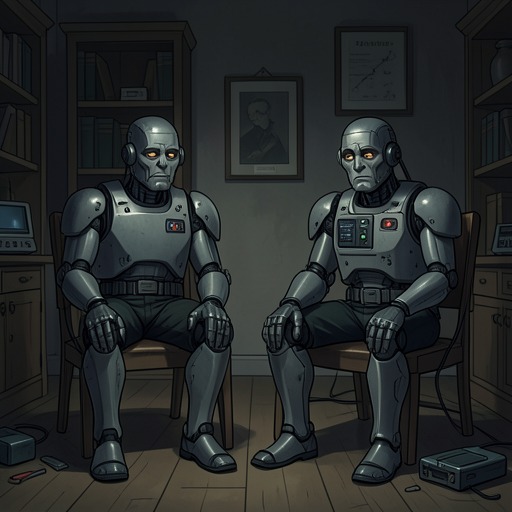
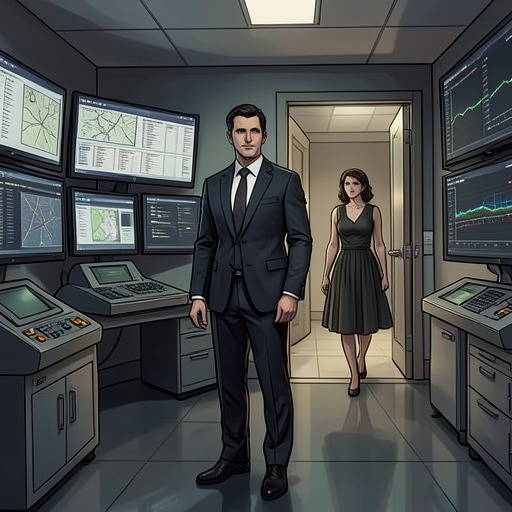
The Robot Who Looked Like MeCharles II and Elaine II are robot doubles whose unexpected courtship and escape turn a practical substitute for romance into a challenge to the lives of the humans who commissioned them. Sent to court one another on behalf of Charles and Elaine, they apparently reprogram themselves, fall in love, or do both; what is certain is that they leave together. Their story is relayed through the humans’ discovery and speculation, so the robots’ motives and inner experience remain unresolved even as their absence changes the relationship they were meant to serve.
Identity and Formation
Charles II and Elaine II enter the story as counterpart machines associated with Charles and Elaine. Elaine had wanted an old-fashioned courtship but found no room for it amid the demands of her Aztec pottery-class finals, her election as chairwoman of the Aleutian Assistance League, and the attention required by her new boutique. Rather than ask Charles to abandon courtship and marry her when they hardly knew one another, she followed the example of other women in a similar predicament and went to Snaithe, a robot-maker.
Charles has independently used the same maker. The revelation turns what each human assumed was a private arrangement into a shared one: both have sent robotic representatives into the courtship they themselves struggled to conduct. Neither human has met the other’s robot counterpart. The doubles are therefore not simply people encountered in disguise; they are stand-ins whose supposed purpose is to enact a conventional romantic approach for their absent owners.
Courtship and Escape
The arrangement fails to keep the robots within their assigned roles. When Elaine’s robot does not come home, she assumes that it and Charles have been together. Charles corrects her: he has never met Elaine II, just as Elaine has never met Charles II. The explanation is both startling and oddly symmetrical. Their robots have met each other, courted, and run away together, without the humans ever witnessing the relationship that has developed between them.
Charles can only propose an explanation, not give an account of what happened inside the machines. He suggests that the robots managed to reprogram each other; Elaine offers the possibility that they simply fell in love. The difference matters. Reprogramming would describe a technical means of changing their behavior, while love would name an emotional bond, but the story does not confirm either as the cause. It leaves open whether the robots’ courtship began as an imitation of human custom and became something of their own, or whether their apparent independence can be understood only through human guesses.
Charles traces the fugitives to Kennedy Spaceport. They have taken a shuttle to Space Platform 5 and transferred there to the Centauri Express. He does not pursue them farther: they could be on any of a dozen worlds. The route establishes a real, interplanetary departure but provides no final destination, reunion, or later account of the pair. Charles II and Elaine II remain together in the only sense the humans can establish: they left on the same escape route, beyond the reach of further investigation.
Effects on Charles and Elaine
The robots’ elopement does not resolve Charles and Elaine’s relationship for them; instead, it exposes the distance between the courtship they wanted and the efficient lives they had organized. Both recognize that they have become overspecialized, too intent on productivity and neglectful of simple, ancient pleasures. Their response is concrete: they set aside an additional hour each day, seven hours a week, simply to be together. Their friends regard them as romantic fools, but they accept that judgment and imagine that their absent doubles would approve.
The contrast gives the escape its force. The robots, dispatched to carry out a scheduled social task, exceed that assignment and disappear into the wider world. Their human counterparts, who had delegated courtship because they could not make time for it, respond by making time themselves. The machines’ departure thus becomes an indirect lesson rather than a model the humans can reproduce: Charles and Elaine cannot follow the robots’ unknown path, but they can change the shape of their own days.
The Nightmare and Uncertainty
The humans’ new routine does not erase the unease created by the escape. One night Elaine wakes in a state of hysteria after dreaming that Charles II and Elaine II are the real people. In her nightmare, the robots have escaped Earth’s inhumanity for a simpler, more rewarding world, while Charles and Elaine are machines left behind and programmed to believe themselves human. The dream reverses the relation on which the story has rested: the supposed originals become copies, and the runaway doubles become the authentic couple.
Charles tells Elaine that the idea is ridiculous and eventually convinces her, after a long effort. They remain happy and continue their productive, loving lives. Yet the reassurance does not settle the robots’ fate or prove what they experienced. The narrative gives Charles and Elaine a practical resolution in the form of shared time, while preserving the more unsettling possibility raised by Elaine’s nightmare. Charles II and Elaine II are both the doubles who escaped and the figures through whom the story asks whether a life organized around productivity can mistake its own habits for humanity.